Case study · Side project · 2026
Print3D StudioFrom a sentence to a sliced print.
A desktop CAD workbench where Claude writes the geometry, inspects its own renders, checks printability and slices for my Bambu Lab A1. It's a full loop from a sentence or a photo to a print-ready 3MF, with every version kept as a readable Python script.
- Role
- Solo: design, engineering, UX
- Timeline
- Oct – Nov 2026
- Platform
- Linux desktop (Electron, .deb)
- Core
- Claude Agent SDK + build123d
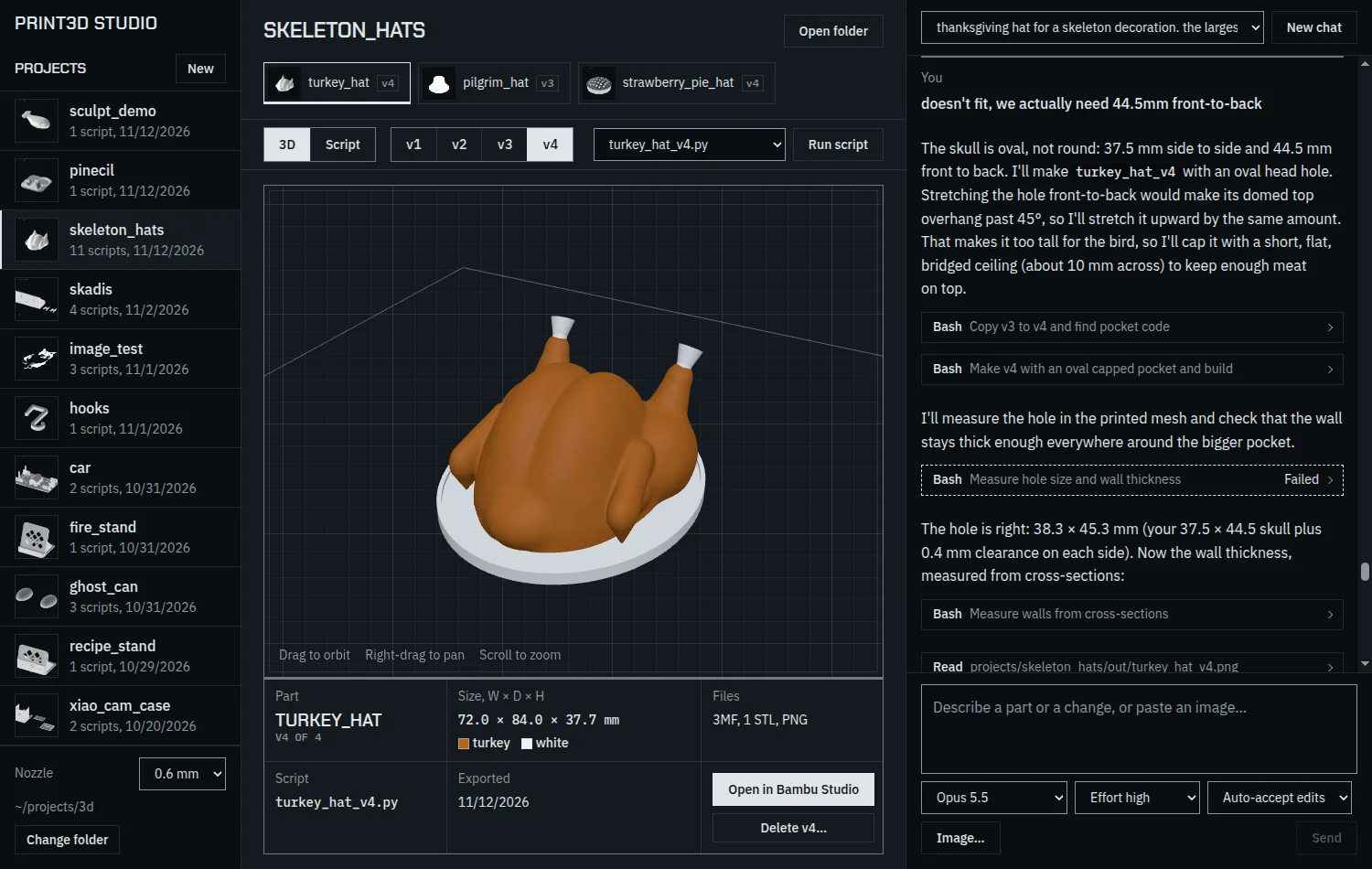
The real app: a test print didn't fit, so Claude re-shapes the head pocket, measures the new mesh and re-checks the walls.
11
projects
30
part scripts
36
sliced 3MF files
~4.6k
lines of TS + Python
The problem
Modeling a small functional part in traditional CAD takes far longer than printing it. Asking a general-purpose LLM for geometry gets you something that looksplausible and fails on the bed: floating islands, unsupported overhangs, walls thinner than the nozzle, holes that don't fit the hardware.
The approach
Give the model the same tools and feedback a careful engineer has: code-first parametric CAD, a printability analyzer that knows the fitted nozzle, renders it must look at, and a real slicer. Then wrap it in a focused desktop app so the loop of describe, review, tweak and print takes minutes.
How it works
- 01
Describe
Plain English or a dropped image: “a wall hook for a 30 mm broom handle, two M4 screws.”
- 02
Model
Claude writes a parametric build123d script, or sculpts a signed distance field for organic forms.
- 03
Check
export() verifies a watertight, single-body mesh, flags overhangs, mid-air starts, bridges and thin walls.
- 04
Review
Multi-view renders and cross-sections are fed back to the agent, which inspects them and iterates.
- 05
Slice
Bambu Studio runs headless with flattened presets, matched to the fitted nozzle, producing a print-ready 3MF.
$ uv run projects/skeleton_hats/turkey_hat_v4.py
size:  72.0 × 84.0 × 37.7 mm
check: OK  one watertight body, fits the bed, sits on z=0
print: support-free · pocket capped by a ~10 mm bridge · ≥5 mm wall above it
slice: 0.6 mm nozzle · 0.24 mm layers · 2 walls · 2 h 0 min · 57 g
Parts it designed
Rendered from the exported meshes. Each one came out of a short conversation and was sliced for the A1. They range from multi-colour sculpted figures to an enclosure fit-checked against a manufacturer's STEP model.
Turkey hat
Sculpted · 2 colours
72 × 84 × 38 mm
Strawberry pie hat
Sculpted · 2 colours
Woven lattice over a strawberry-rhubarb fill
Whale
Sculpted · 2 colours
74 × 45 × 28 mm
Tuxedo cat relief
Photo → heightmap · 4 colours
Traced from a photograph
XIAO ESP32-S3 camera case
build123d · enclosure
Fit-checked against Seeed’s STEP model
Pilgrim hat
build123d · 3 colours
Support-free head pocket
Pinecil soldering-iron stand
build123d · functional
Tip-up cradle + brass-wool cup pocket
Halloween recipe stand
build123d · skull relief
A4 easel, one piece, no supports
IKEA Skådis screwdriver rack
build123d · v4
Clip-on hooks, support-free
Iteration as versions
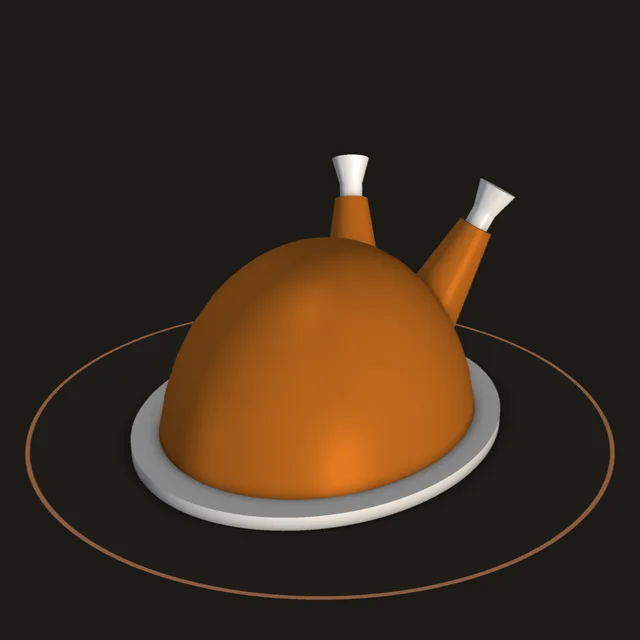
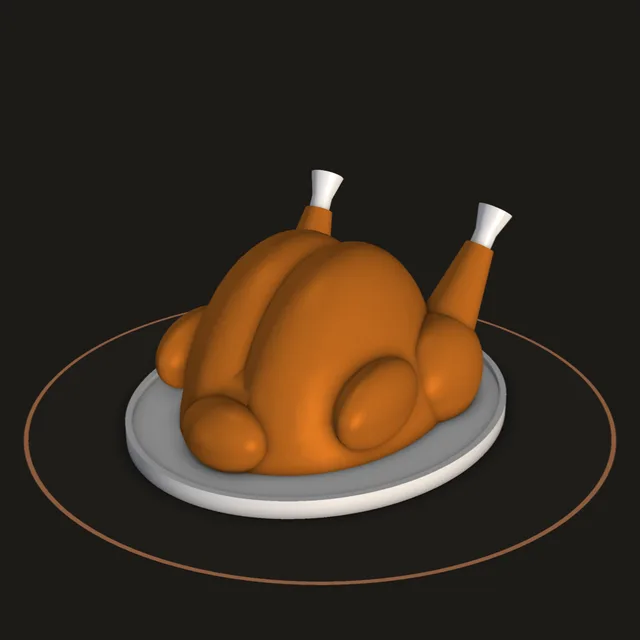
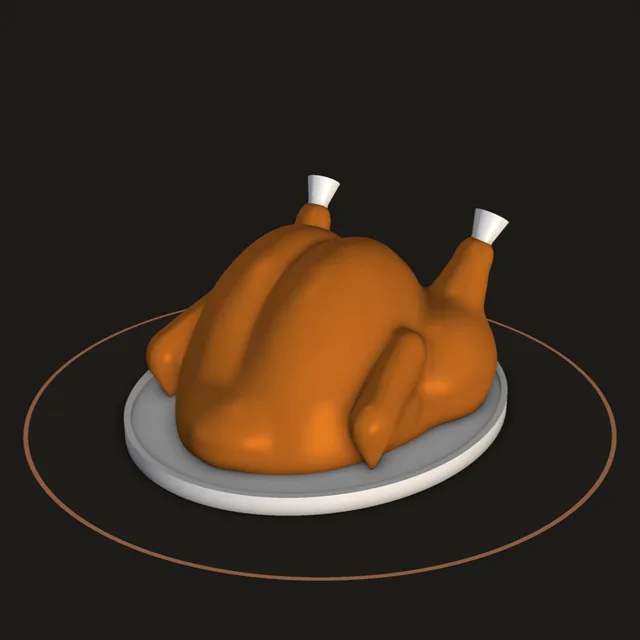
A redesign never overwrites: the agent copies the script to _v<n+1>, and the app groups versions under one part with a switcher, so any step can be compared or restored. Here is the turkey hat, step by step.
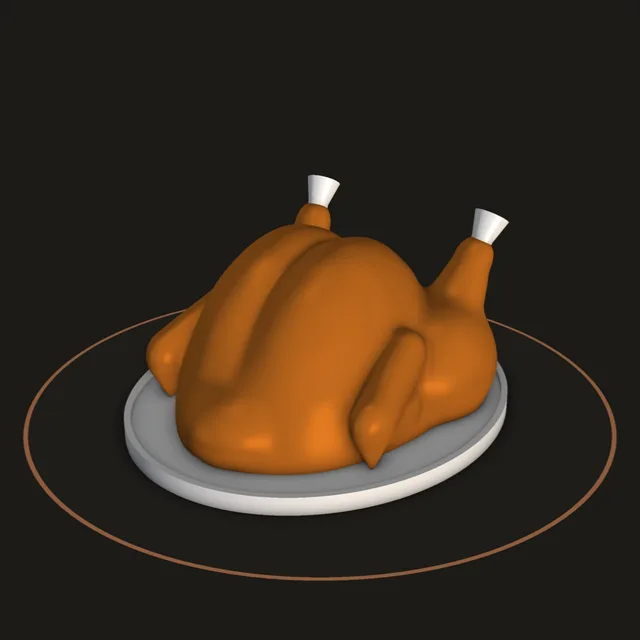 turkey_hat_v4.py
Fitted to the real skull
After a test fit (“doesn't fit, we need 44.5 mm front-to-back”) the agent stretched the pocket into an oval, scaling it upward by the same factor to keep every slope ≥ 45°, then capped it with a 10 mm bridge and measured the result: 38.3 × 45.3 mm.
Printability analysis
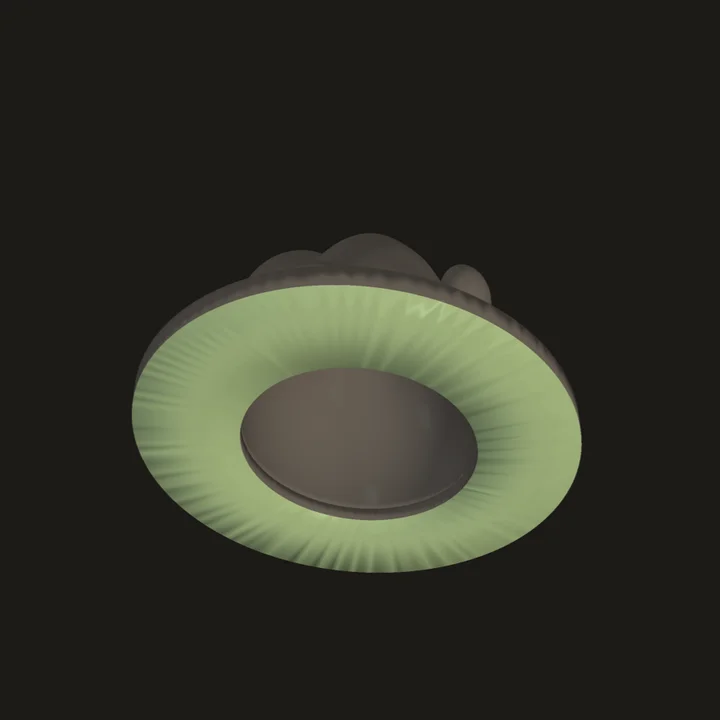
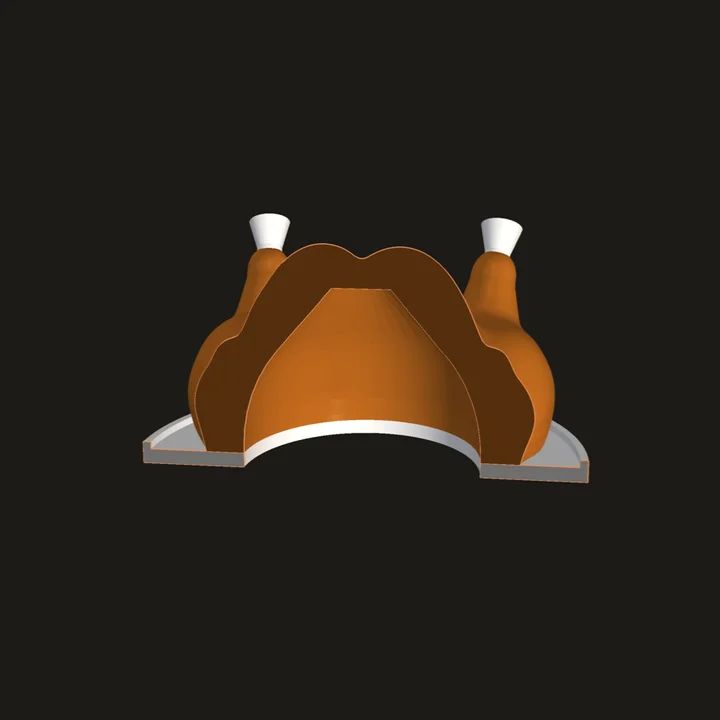
Seeing what a slicer would struggle with
Previews hide what matters for a print. The check pass paints every face that leans past 50°, finds points where a layer would start on nothing, measures bridge spans, and samples the thinnest wall against two line widths of the fitted nozzle.
The agent reads these images and the print: notes after every run, and fixes the design before turning on supports.
The desktop app
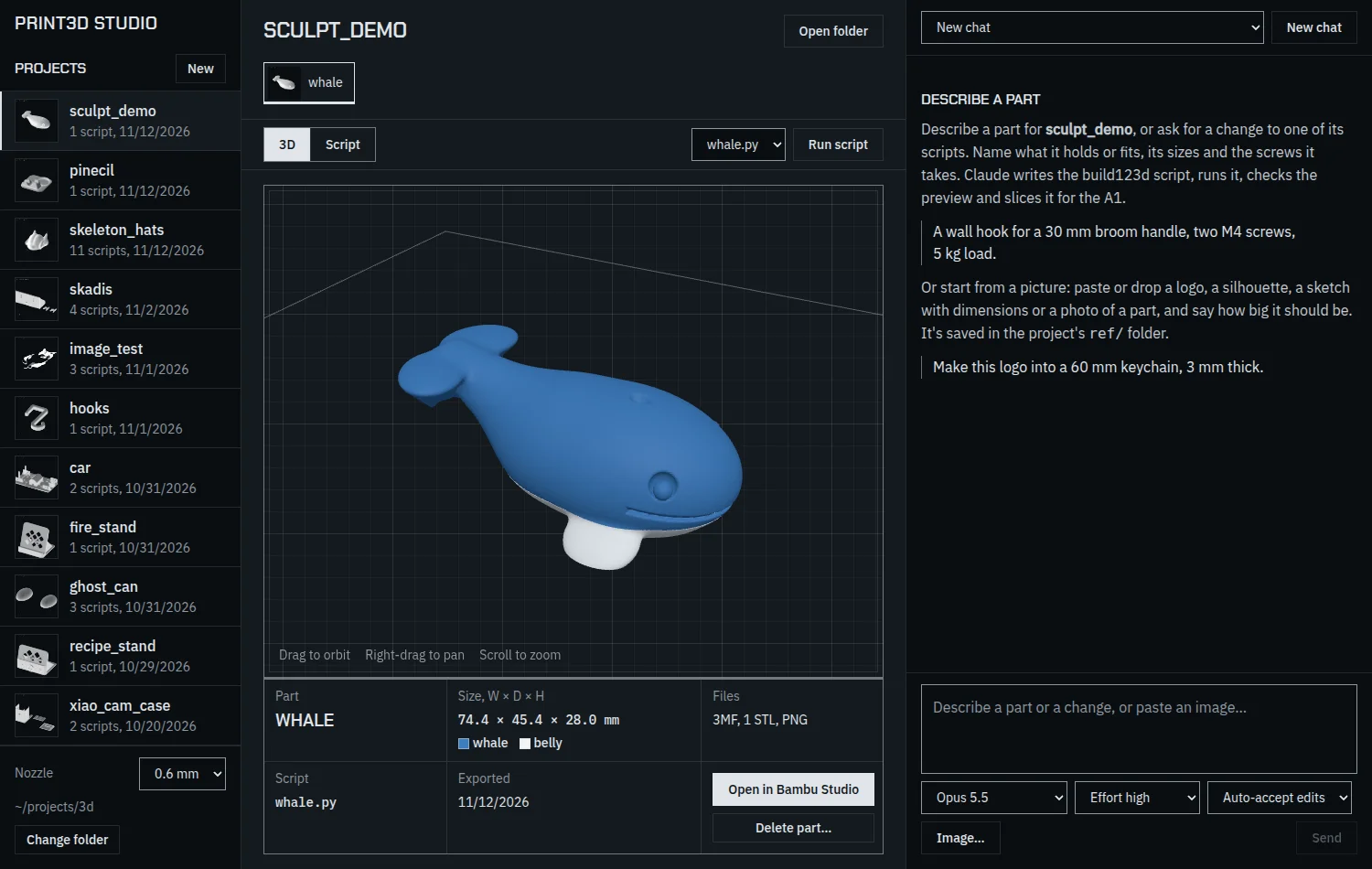
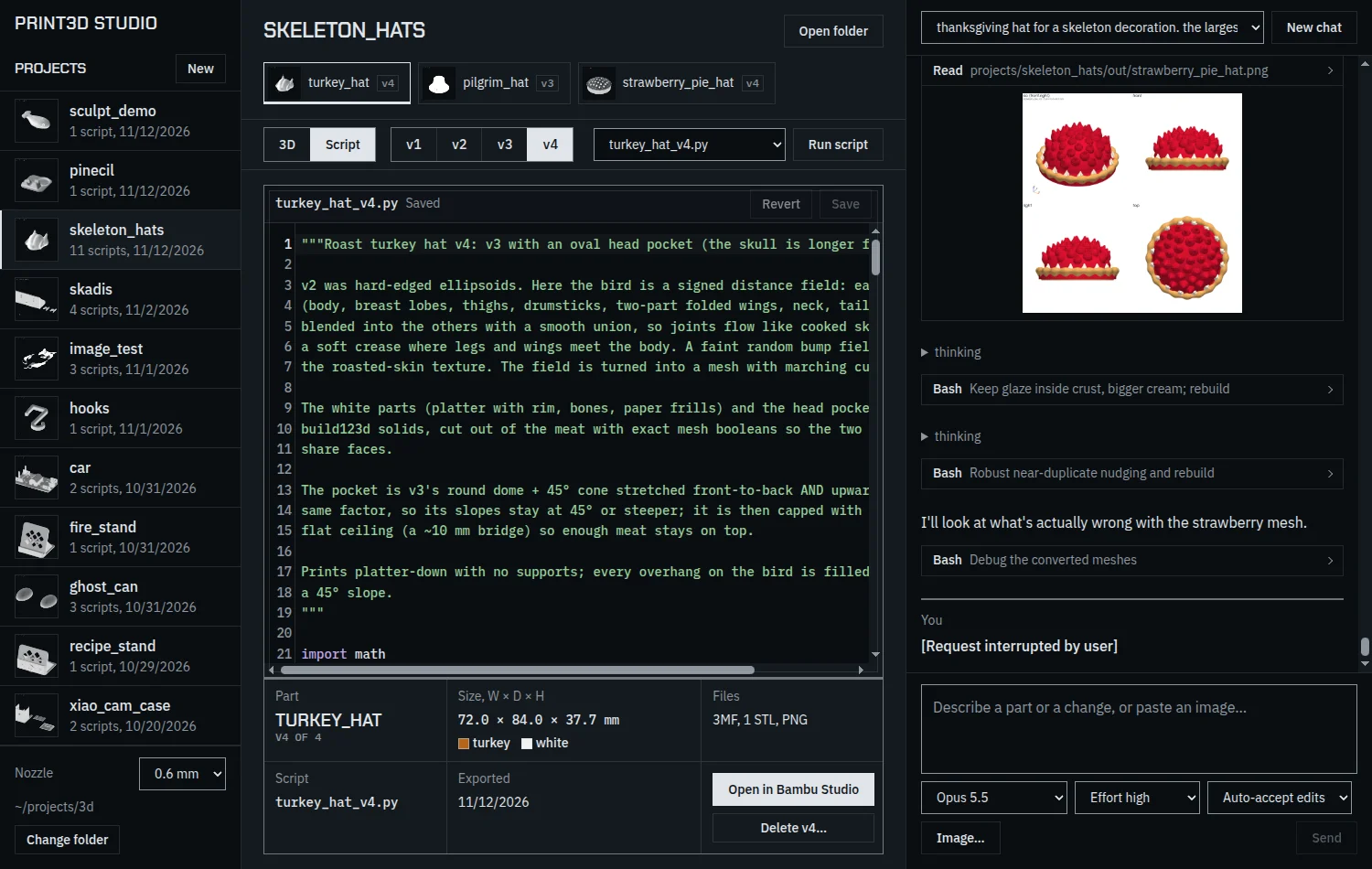
Three-panel workspace
Projects, part viewer/editor and chat side by side, all live-refreshing from disk.
Versions as first-class
_v2, _v3… exports collapse into one part with a version switcher.
Images in, geometry out
Paste a logo or a photo; it's saved to ref/ and traced or used for proportions.
Model, effort, permissions
Pick the model and effort per chat; ask, auto-accept, auto or plan-only modes.
Nozzle-aware
Switch 0.2–0.8 mm in the sidebar; every part re-slices for it on its next run.
One-click hand-off
Open the sliced project in Bambu Studio, ready to send to the printer.
Engineering highlights
A closed feedback loop for the agent
Every export renders four views plus a checkimage (back, underside, two sections) at the exact resolution Claude reads without downscaling. The project's CLAUDE.md makes reviewing them mandatory, so the model critiques its own geometry before calling a part done.
Printability analysis, not just validity
Per-face overhang masks, connected-component patch sizing, detection of layers that would start in mid-air, bridge spans and a sampled thinnest-wall measurement, all scaled to the nozzle currently fitted.
Sculpting as numpy arithmetic
Organic shapes are signed distance fields on a voxel grid, blended with smooth unions and meshed with marching cubes. printable()fills under every overhang to a 45° slope “like wax running down,” so figures print without support.
Headless slicing that actually works
Bambu Studio's CLI doesn't resolve preset inheritance, so the slicer module flattens parent → child presets itself and swaps quality tiers across 0.2–0.8 mm nozzles, returning time and filament estimates with every run.
Resilient CAD finishing
OpenCascade fillets fail the whole part on a single bad edge and sometimes silently tear faces. soften() walks the radius down, re-meshes each attempt to verify it still closes, and reports what it achieved.
A long-lived agent per project
The Electron main process keeps one Claude Agent SDK session per project, fed by an async-iterable inbox so a single session takes many messages, with typed permission prompts relayed to the UI and resumable chat history.
print3d/ · Python toolkit
- export()
- STL, STEP, previews, check and sliced 3MF in one call
- analyze
- Overhangs, mid-air starts, bridges, bed contact, wall thickness
- sculpt
- SDF primitives, smooth booleans, mirror, noise, printable()
- image
- Trace logos and silhouettes; colour-region and photo reliefs
- finish
- soften(): fault-tolerant fillets and bed chamfers
- slicer
- Preset flattening, nozzle-aware quality tiers, CLI slicing
- view
- Close-ups and arbitrary cross-sections on demand
app/ · Electron + React
- main.ts
- Window, IPC and a proj:// protocol serving project files
- agent.ts
- Agent SDK sessions, streaming input, permission relay
- projects.ts
- Project scan, file watcher, uv and Bambu Studio launchers
- StlViewer
- three.js viewer with per-colour meshes and orbit controls
- ScriptEditor
- CodeMirror Python editor with on-disk change detection
- Chat
- Markdown transcript, tool cards, image paste to ref/
Takeaway
The model was never the bottleneck. The work was building the instruments it needs to see its own mistakes: analysis, renders and a real slicer, plus a UI that keeps a human one click from every decision.